> For the complete documentation index, see [llms.txt](https://ryukiedev.gitbook.io/wiki/llms.txt). Markdown versions of documentation pages are available by appending `.md` to page URLs; this page is available as [Markdown](https://ryukiedev.gitbook.io/wiki/shu-ju-jie-gou-yu-suan-fa/jian-zhi-offerswift/52.-liang-ge-lian-biao-de-di-yi-ge-gong-gong-jie-dian.md).
# 52.两个链表的第一个公共节点
### 一、 题目
输入两个链表,找出它们的第一个公共节点。
如下面的两个链表:
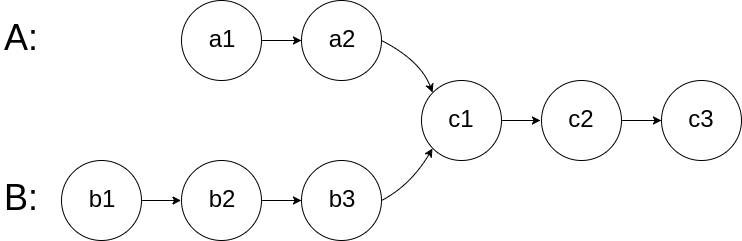
在节点 c1 开始相交。
**示例 1:**
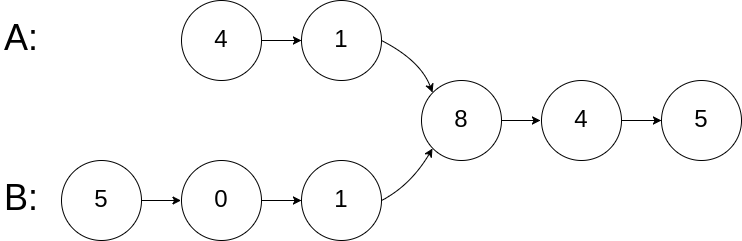
输入:intersectVal = 8, listA = \[4,1,8,4,5], listB = \[5,0,1,8,4,5], skipA = 2, skipB = 3
输出:Reference of the node with value = 8
输入解释:相交节点的值为 8 (注意,如果两个列表相交则不能为 0)。从各自的表头开始算起,链表 A 为 \[4,1,8,4,5],链表 B 为 \[5,0,1,8,4,5]。在 A 中,相交节点前有 2 个节点;在 B 中,相交节点前有 3 个节点。
**示例 2:**
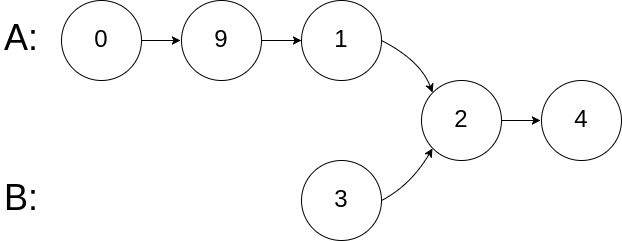
输入:intersectVal = 2, listA = \[0,9,1,2,4], listB = \[3,2,4], skipA = 3, skipB = 1
输出:Reference of the node with value = 2
输入解释:相交节点的值为 2 (注意,如果两个列表相交则不能为 0)。从各自的表头开始算起,链表 A 为 \[0,9,1,2,4],链表 B 为 \[3,2,4]。在 A 中,相交节点前有 3 个节点;在 B 中,相交节点前有 1 个节点。
**示例 3:**
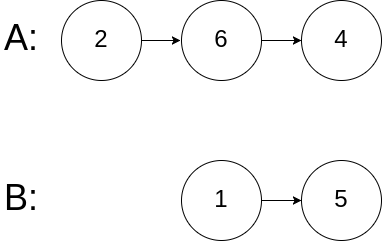
输入:intersectVal = 0, listA = \[2,6,4], listB = \[1,5], skipA = 3, skipB = 2
输出:null
输入解释:从各自的表头开始算起,链表 A 为 \[2,6,4],链表 B 为 \[1,5]。由于这两个链表不相交,所以 intersectVal 必须为 0,而 skipA 和 skipB 可以是任意值。
解释:这两个链表不相交,因此返回 null。
**注意:**
如果两个链表没有交点,返回 null.
在返回结果后,两个链表仍须保持原有的结构。
可假定整个链表结构中没有循环。
程序尽量满足 O(n) 时间复杂度,且仅用 O(1) 内存。
本题与主站 160 题相同:
来源:力扣(LeetCode)
链接:
著作权归领扣网络所有。商业转载请联系官方授权,非商业转载请注明出处。
### 二、 分析
示例1,中看到公共节点位8,而不是1。可能有些同学会感到很疑惑。但其实这里两个节点的比较并不是数值的比较,而是内存地址的比较。同样值是1,但却是两个不同内存地址的两个节点。知道这个前提,这个题目就很简单两。
### 三、题解
本体没有官方 Swift 用例。这里我们自己构造数据结构
#### 3.1 ListNode
```
public class ListNode: Equatable {
public static func == (lhs: ListNode, rhs: ListNode) -> Bool {
Unmanaged.passUnretained(lhs).toOpaque() == Unmanaged.passUnretained(rhs).toOpaque()
}
public var val: Int
public var next: ListNode?
public init(_ val: Int) {
self.val = val
self.next = nil
}
}
```
#### 3.2 题解
```
func getIntersectionNode(headA: ListNode, headB: ListNode) -> ListNode? {
var temp: [ListNode] = []
var headA: ListNode? = headA
var headB: ListNode? = headB
while let a = headA {
temp.append(a)
headA = a.next
}
while let b = headB {
if temp.contains(where: { $0 == b }) {
return b
}
headB = b.next
}
return nil
}
```
#### 3.3 用例
```
let n0 = ListNode(0)
let n11 = ListNode(1)
let n12 = ListNode(1)
let n4 = ListNode(4)
let n42 = ListNode(4)
let n51 = ListNode(5)
let n52 = ListNode(5)
let n8 = ListNode(8)
// [4,1,8,4,5]
n4.next = n11
n11.next = n8
n8.next = n42
n42.next = n52
// [5,0,1,8,4,5]
n51.next = n0
n0.next = n12
n12.next = n8
let res = getIntersectionNode(headA: n4, headB: n51)
print(res?.val)
```